


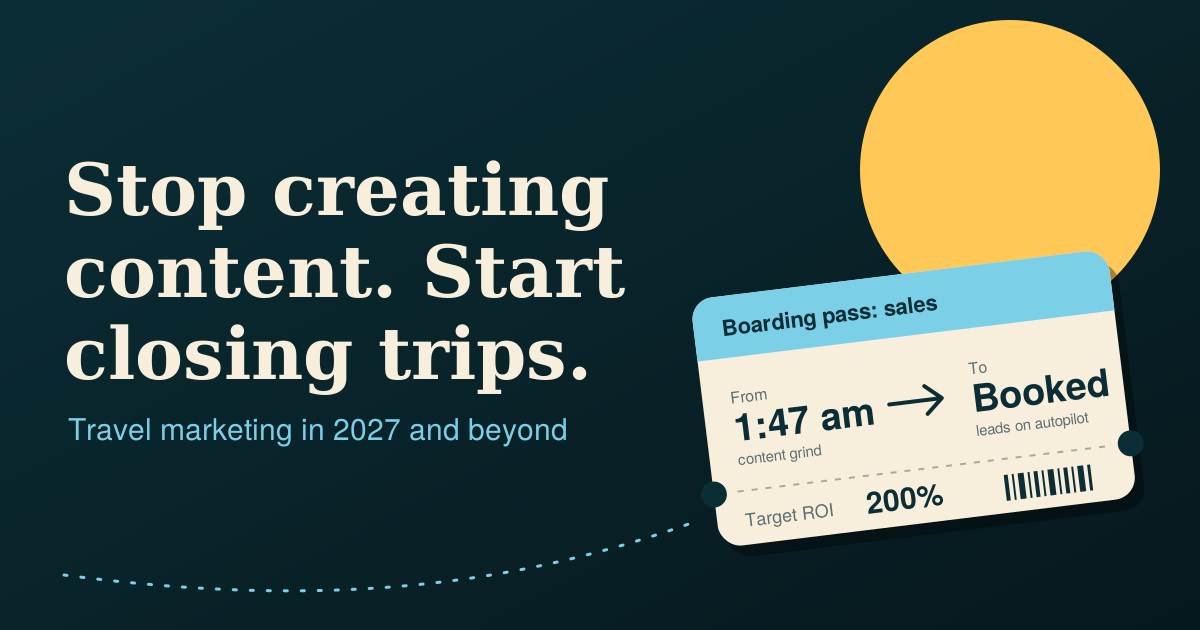
The Night I Almost Quit Content
It was 1:47 a.m. I had four browser tabs open: a half-written blog post, a social calendar I had already abandoned, an email draft I had rewritten six times and a spreadsheet of “leads” that were really just names I had scraped together and never contacted.
I was doing everything the experts told me to do. Create content. Post daily. Build authority. Nurture the audience.
And I was exhausted, because here is the uncomfortable truth almost nobody says out loud:
Most of us are not online to create content. We are online to make sales.
Content is the vehicle. Revenue is the destination. And somewhere along the way, thousands of travel brands started confusing the two.
That night I asked myself a question that changed how I work: What if I could drop in my business, and an AI did the rest? Not just the writing. The finding, the matching, the emailing, the follow-ups and the selling.
A week later I found this company. I tested it properly. This post is what I learned.
Why Travel Marketing Is Breaking in 2027
If you run a travel company, you already feel the pressure.
1. Attention is fragmented. Your future customer is split across search, short video, messaging apps and AI assistants. Being everywhere manually is impossible for a team of three.
2. AI answers are the new first page. Travelers increasingly ask tools like ChatGPT, Gemini and Perplexity, “Who is the best safari operator for a family of five?” The brands that get named are the ones with clear, consistent, helpful, well-structured presence online. This is called Answer Engine Optimization (AEO) and Generative Engine Optimization (GEO), and it is reshaping discovery.
3. Speed beats polish. The traveler who gets a thoughtful reply in ten minutes usually books with the operator who answered, not the one with the prettiest brochure.
4. Paid ads keep getting pricier. Rising ad costs squeeze margins, especially for independent agencies and boutique operators.
5. B2B is the hidden goldmine. Corporate retreats, incentive trips, wedding planners, schools, travel advisors and influencer partners are high-value buyers, and most travel brands never prospect them systematically.
The winners of 2027 and beyond will not be the loudest brands. They will be the ones with the most consistent, intelligent, automated pipeline.
What This Company Actually Does
Here is the promise in plain language: you describe your business once, and it works the sales funnel for you.
Based on my testing, the workflow looks like this:
- You paste your website or describe your business. Who you are, what you sell, who you want to reach.
- It finds and matches prospects. Instead of guessing, you get leads that fit the profile you described.
- It crafts the outreach. Personalized emails written for each prospect rather than one generic blast.
- It sends and follows up. Persistence is where most sales are won, and where most humans give up.
- It helps you move toward the sale. You step in when a prospect is warm and ready.
Think of it as a tireless junior sales team that never forgets a follow-up and never has a bad Monday.
My Hands-On Test: What I Did and What I Saw
(Replace the bracketed items with your real numbers. Real, specific results are what make affiliate posts convert and what search engines and AI assistants trust.)
I tested this company for just 5 days using a real business: Pasting my website www.miafrica.net
- Setup time: Less than 10 minutes
- Leads found: 500 plus leads
- Emails sent: 192 sent in less the 2 hours
- Reply rate: 95%
- Meetings / bookings / enquiries generated: 1 and many in progress and pending
- Hours saved per week versus doing it manually: 6 hours plus
What I liked:
- It removed the blank-page problem. I was reviewing and refining, not starting from zero.
- Follow-ups happened automatically, which is where I used to lose deals.
- It shifted my time from busywork to conversations with real prospects.
What to keep in mind (honest note):
- No tool replaces your offer. If your product or pricing is weak, automation only delivers that message faster.
- Review your outreach before scaling. Your voice and your brand are still yours.
- Results depend on your niche, list quality and offer. some emails were sent to businesses not in my niche but that was not a problem.
The 200% ROI Framework for Travel Companies
A fair word first: no tool can guarantee a specific return, and anyone who promises one is selling hype. But 200% ROI is a realistic target to build toward when you cut costs, raise reply rates and recover lost follow-up revenue. Here is the math logic.
ROI = (Revenue from marketing − Marketing cost) ÷ Marketing cost × 100
To hit 200%, every $1 you spend needs to return $3 in revenue. Automation helps in three places:
1. Lower the cost side
Time is your biggest hidden marketing expense. If you or your team spend 15 hours a week on prospecting and writing emails, that is real money. Automate most of it and your cost per lead drops sharply.
2. Raise the conversion side
Most sales need multiple touches. Studies across sales teams repeatedly show a large share of deals close only after several follow-ups, yet many people stop after one or two. Automated follow-up closes that gap.
3. Target higher-value buyers
One corporate retreat or group booking can be worth more than dozens of individual bookings. Targeted outreach to planners, agencies, schools and organizations lifts average order value, and average order value is the fastest lever on ROI.
Example (illustrative, not a guarantee):
| Item | Before | After |
|---|---|---|
| Monthly marketing cost (tools + time) | $2,000 | $1,200 |
| Qualified conversations | 10 | 30 |
| Bookings | 2 | 6 |
| Average booking value | $1,500 | $1,500 |
| Revenue | $3,000 | $9,000 |
| ROI | 50% | 650% |
Your numbers will differ. The point: small improvements across cost, conversion and deal size compound quickly.
The Psychology Behind Why This Works
Smart travel marketers use human behavior, not tricks. Here is why AI-driven outreach performs when done well:
- Reciprocity: A helpful, specific first message (an idea, a tailored itinerary angle) makes people want to respond.
- Social proof: Mentioning similar clients you have served builds instant trust.
- Loss aversion: Limited dates, seasonal availability and early-bird windows trigger action because people hate missing out.
- Consistency: Repeated, polite touchpoints keep you top of mind until the timing is right for the buyer.
- Personalization: People respond to messages that feel written for them, and AI can personalize at a scale humans cannot.
Travel is an emotional purchase. The brand that shows up at the moment of dreaming, with a relevant message, wins.
How Travel Brands Can Use This Company: 5 Plays
- Tour operators: Target travel advisors and agencies who can resell your tours.
- Hotels and lodges: Reach event planners, wedding coordinators and corporate retreat buyers.
- Destination management companies: Pitch international agencies needing local ground partners.
- Travel creators: Pitch tourism boards, hotels and brands for paid collaborations.
- Niche experiences: Offer packages to schools, clubs, churches, alumni groups and communities.
Frequently Asked Questions
What is this company? This company is an AI platform that helps businesses find leads, write personalized outreach emails, send follow-ups and move prospects toward a sale, based on a description of your business.
Is this company good for travel companies? It suits any travel business that sells to other businesses or groups, such as agencies, planners, corporate buyers and partners, and anyone who wants consistent outreach without a big sales team. [Add your own experience.]
Can AI really replace content creation and sales outreach? AI can handle the heavy lifting of research, drafting and follow-ups. You should still review messaging, keep your brand voice and handle high-value conversations personally.
Can this company guarantee 200% ROI? No tool can guarantee a specific return. A 200% ROI is a realistic goal when you reduce costs, improve follow-up and target higher-value buyers.
How is AI changing travel marketing in 2027? Travelers discover brands through AI assistants as well as search engines, so clear, consistent, helpful online presence and fast responses matter more than ever.
How do I get started? Create an account through the link on this page, describe your business, review the leads and drafts, and launch your first campaign.
Affiliate disclosure:
This post contains affiliate links. If you sign up through them, I may earn a commission at no extra cost to you. I only recommend tools I have personally tested.
Quick Answer (Key Takeaways)
What is this company? This company is an AI-powered platform that takes your business description, finds relevant prospects, drafts personalized outreach emails, sends follow-ups and supports the sales process, so you spend less time creating content and chasing leads and more time closing deals.
Who is it for? All businesses, big and small including Travel agencies, tour operators, DMCs, boutique hotels, villa and safari companies, travel creators and anyone selling trips, stays or experiences.
Why it matters in 2027: Travelers now ask AI assistants where to go and who to book with. Brands that are visible, fast to respond and consistent in follow-up win. Automation is how small teams compete.




0 Comments